HashMap
- Internal structure
- (1) The interface Map<K,V>: The Java HashMap class implements it main methods:
- V put(K key, V value)
- V get(Object key)
- V remove(Object key)
- Boolean containsKey(Object key)
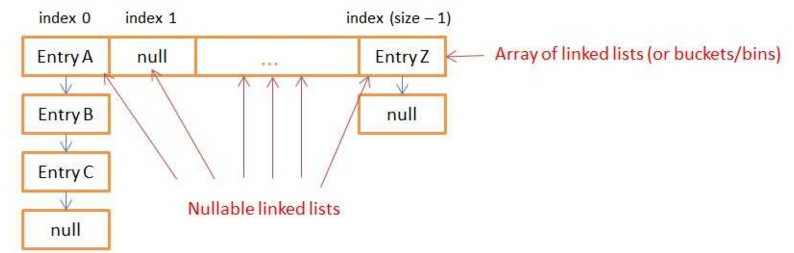
- (2) the Entry<K, V>: is used to keep data.
- key-value pair
- two extra data:
- a reference to another Entry(like linked list)
- a hash value that represents the hash value of the key ( avoid the computation of the hash every time)
static class Entry<K,V> implements Map.Entry<K,V> { final K key; V value; Entry<K,V> next; int hash; … } -
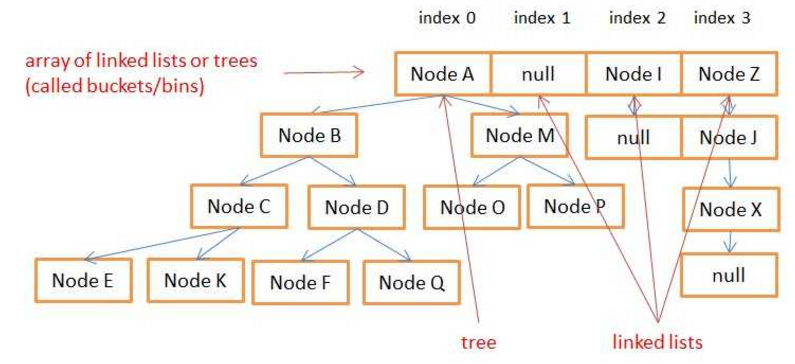
- (3) buckets or bins: multiple singly linked lists of nullable entries ; default capacity is 16
- Three Steps:
- gets the hashcode of the key
- rehashes the hashcode to prevent against a bad hashing function
- rehashed hash hashcode and bit-masks it(optimized modulo function)
// the “rehash” function in JAVA 7 that takes the hashcode of the key static int hash(int h) { h ^= (h »> 20) ^ (h »> 12); return h ^ (h »> 7) ^ (h »> 4); } // the “rehash” function in JAVA 8 that directly takes the key static final int hash(Object key) { int h; return (key == null) ? 0 : (h = key.hashCode()) ^ (h »> 16); } // the function that returns the index from the rehashed hash static int indexFor(int h, int length) { return h & (length-1); }
- Three Steps:
- (1) The interface Map<K,V>: The Java HashMap class implements it main methods:
the size of the inner array needs to be a power of 2. For Example size is 17: bitwise formula “H AND 16” is going to be either 16 or 0. size is 16: the range of the bitwise index formula “H AND 15” is from 0 to 15
HashMap Auto Resizing
the HashMap is able to increase its inner array in order to keep very short nullable linked lists. public HashMap(int initialCapacity, float loadFactor): the default initialCapacity is 16 && default loadFactor is 0.75.
- if it needs to increase the capacity of the inner array?:
- Each time we add a new key/value in your Map with put(…)
- The size of the map & A threshold
- the resizing of the array creates twice more buckets
- redistributes all the existing entries into the buckets (the old ones and the newly created).
- the HashMap only increase the size of the inner array, it wouldn’t decrease it.
Thread Safety
- (1)The HashMap is not threads safe. (Because of auto-resizing mechanism)
- (2)The HashTable is a thread safe. (SLOW: CRUD methods are synchronized)
- (3)The ConcurrentHashMap is smater thread safe implementation. (JAVA5:synchronized bucket)
- multiples threads can get(), remove() or put(), if not accessing the same bucket or resizing
- It is better choice for multithreaded application.
[Worst] when 2 threads save/put value & the 2 put() calls auto resizing at the same time, which would create a inner-loop in a bucket. Trying to get a data, the get(), will never end.
Unchangeable Key
If we create your own Key class and don’t make it changeable. Modifying key may cause value “lost”(exist but cannot be found).
HashMap in JAVA 8
The lines of code about HashMap increases from 1k (JAVA 7) to 2k (JAVA 8)
- A BIG difference: Nodes can be extended to TreeNodes.
-
TreeNodes is a red-black tree structure.O(log(n)) for add, delete or get
static class Node<K,V> implements Map.Entry<K,V> { final int hash; final K key; V value; Node<K,V> next;
-
more exhaustive list of the TreeNodes. Red black trees are self-balancing binary search trees. their length is always in log(n). The inner table can contain both Node (linked list; if 6- nodes in a bucket) and TreeNode (red-black tree; if 8+ nodes in a bucket).
The main advantage: in the same index (bucket), search in a tree will cost O(log(n)) VS. cost O(n) with a linked list in Java 7.
The main disadvantage: the tree takes really more space.
	static final class TreeNode<K,V> extends LinkedHashMap.Entry<K,V> {
	    final int hash; // inherited from Node<K,V>
	    final K key; // inherited from Node<K,V>
	    V value; // inherited from Node<K,V>
	    Node<K,V> next; // inherited from Node<K,V>
	    Entry<K,V> before, after;// inherited from LinkedHashMap.Entry<K,V>
	    TreeNode<K,V> parent;
	    TreeNode<K,V> left;
	    TreeNode<K,V> right;
	    TreeNode<K,V> prev;
	    boolean red;
Red black trees are self-balancing binary search trees. their length is always in log(n)